
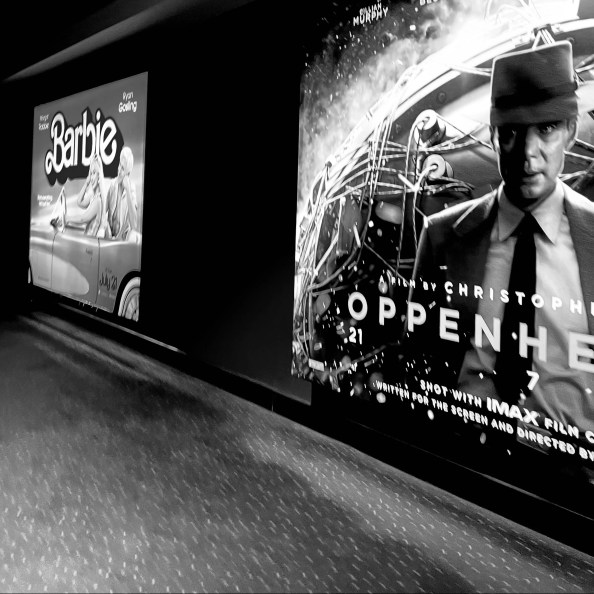
A strange collision of imaginary worlds took place last weekend. It was an exciting and proud moment for the industry to see two films go head to head in the first summer blockbuster clash in years. Not every film in the game lived up to the hype however. This weekend taught me three key things 1) you can literally market anything 2) you can’t make a movie out of a manifesto and 3) sometimes the best marketing is through word of mouth.
SATURDAY – Doll, you can’t make a movie out of a manifesto: Why the marketing was the only redeeming quality of the Barbie movie
It was all about the hype. How did none of us see it coming? Those who like to see ourselves as wannabe movie marketers were oblivious, and blindly went along with the marketing hype for the Barbie movie – we basically drank our own Kool Aid. This reviewer raved about the marketing stunts and clever brand deals only a few weeks ago. At the various Barbie premieres in the weeks leading up to it, fashion and fitness influencers with a lucky pink ticket raved about the film, “You guys have to go see this – I cried twice!” they proclaimed to thousands of eager followers. These kind of proclamations, whether it was true or not only added to it.
What this long-anticipated weekend has taught me most however is that you can literally market anything, and Warner Brothers knew full well that in order to make a return on investment it had to dress the mutton up as lamb and serve it up proudly on the world stage. To distract from the movie itself, Warner Brothers was judged on its marketing efforts, and ultimately how deep its pockets were. The hype overtook the movie itself, snowballing itself into its opening weekend, so that when people finally saw it they might be more inclined to go along with it, for all its flaws. It might not surprise you that I don’t intend to follow that.
Essentially, Barbie wakes up one day and realises that she’s more than a doll – she’s finally self conscious. I guess you could say it’s like an Adam and Eve moment, but think Barbie’s Dream House, rather than the Garden of Eden. Through several “morning Barbie, morning Ken” (s) to various other dolls, she realises there’s more to life than this and has an existential crisis that throws her into the “real world.” A fish out of water sequence takes place with Barbie ending up being jeered at, incredibly managing to look out of place on Venice Beach – the epicenter for looking out of place. To Barbie’s horror, the real world is controlled by men, while women are second class citizens. If Betty Friedan was alive today, I think even she’d disagree with that reductionist view.
The plot seems simple enough, but if only it were that simple. One of my first unfiltered thoughts were, “oh no, Barbie’s political,” as some contrived dialogue soon revealed. Empty, hollow discussions about empowerment, the patriarchy and identity ensued, which in my opinion is a recipe for a conversation devoid of meaning. Every conversation felt like an obnoxious manifesto, with empty words and promises – but surprise, surprise, you can’t make a movie out of a manifesto. There is nothing inherently wrong with a film being political – at all. Look at all the anti-Vietnam war films of their time that stood for something monumental and meaningful. The difference was they didn’t ram rhetoric down the audience’s throat.
There are genuinely very few redeeming qualities about this movie and I mean this literally. It’s not even the snobbish film critic in me saying this, the general moviegoer in me who I’d recruited just for the day to watch a movie that was ultimately meant to be a bit of fun, is absolutely stumped aswell. Unlike the excellent marketing campaign that preceded it, the film wasn’t even fun to watch. The one element it should have delivered on was comedy and it fell flat – in a packed theatre there were virtually no belly laughs. But most of all, it was the “sellout” of Noah Baumbauch and Gretta Gerwig that surprised me the most – former indie filmmakers, turned Hollywood Golden Gooses. Their gorgeous human-driven repertoires that speak to the individual are so at odds with this society-bashing drivel.
Barbie started life in 1959 as a doll that kids could play with and pretend to be rather than playing the mother role with baby dolls. That was pretty much it. She didn’t stand for anything then, and she doesn’t stand for anything now. This movie just used her famous name and brand as a silly vessel to funnel through the latest, ill-thought out political craze. But a gentle reminder that she is just a doll, not a puppet paying lip service. And this is just a movie, not a hollow campaign trail. So let’s not over complicate things.
SUNDAY – A thought-provoking, well acted, if slightly underwhelming thriller biopic with Oppenheimer
It was important to go see Oppenheimer in the evening, leaving you to fall asleep pondering on the meaning of life and how one person’s time on earth could shake the trajectory of the world forever. Like most of Christopher Nolan’s movies, at his starting gun he throws several strings into your lap, leaving you to untangle them gradually as his vision unfolds. For this reason it is only at the very end do you appreciate Oppenheimer as a fundamentally human, redemptive story. Nolan brings you along on two main tracks, the first is the linear recounting of Oppenheimer’s life from his early days at Oxford to his work on the infamous Manhattan project. The second is a complex and beautiful black and white recounting of Oppenheimer’s downfall after getting mixed up in the McCarthy chaos, which Robert Downey Jr plays his antagonist in exceptionally well.
Cillian Murphy had “the entire movie on his back” as Nolan repeatedly told the press, and he most certainly delivered. There is something very heartening about seeing a Cork man playing a lead role in a global summer blockbuster, and for that it gets immediate, unfair brownie points. He plays the tortured intellectual quite well because Oppenheimer was not a stereotypical anxious or meek scientist, he was self confident and forthright. He therefore has to toe the line between a brilliant quantum physicist with all the answers, and an apologetic person, stoic and unyielding in his attempt to right an almost unforgivable wrong.
The moment everyone was waiting for was when the atomic bomb went off, and Nolan handled this anticipation brilliantly – with complete silence, the mushroom clouds blinding the theatre with a brilliant white. It was at this point you could tell that the younger demographic made their disappointment known through exaggerated sighs, a group that has become accustomed to his major set pieces and explosions. But the reason is obvious, he had to stay true to this by being more of a biopic than a thriller. Because in the moment that Oppenheimer saw that mushroom cloud rise, time must have stood still and he knew he’d stepped over a line in which he’d created a new world, not a new weapon.
Oppenheimer’s character is criticised a lot from each secondary character in the linear recounting of his life as they question his (weak) communist links. Equally, he gets an awful bashing on his security clearance in the present day scenes. In these sequences an older, ponderous Oppenheimer diligently answers each question almost to a fault. His wife is frustrated at not standing up for himself but it becomes clear that it is some sort of penance for what danger he has set upon the world. It reveals that strange dichotomy of human nature, trying to hold two truths in parallel where he was almost forced to create the atomic bomb in fear of it ending up in the wrong hands, and then after attempting to redeem himself by working for good and lecturing on the dangers of misusing nuclear weapons. No matter his motivations however, the critics were trying to nail him before and then trying to nail him afterwards.
Some people have labelled this a “history channel” movie in that it could have been made for TV such is the relatively linear nature of the film. I would argue that it’s more nuanced than that, partly down to the post-Manhattan project courtroom sequences bringing you on another track, but largely down to Murphy’s performance. As usual, you make your mind up about a Nolan movie after you leave the theatre that night, or even that week. You’d forget a history channel movie by the time you switched off the TV. Ultimately, it’s a human story, interwoven with unfathomable physics, and equally exploring the impenetrable depths of the human psyche and he does this well. The reverberations of this story will stay with you long after and maybe that was because the subtle word of mouth and reputation-based approach to its marketing was exactly what this film needed. It was a movie that had a simple premise so intriguing that made you want to see it, it was crafted by one of the most respected modern auteurs, it’s arresting in the moment, but crucially – left you thinking about it long after you’d left the theatre.
 FILM FOR THOUGHT
1 comment