

What a beautifully ugly film.
This is the crux of Johnathan Glazer’s first mainstream film The Zone of Interest, nominated for 5 Academy Awards. The ‘zone’ we are interested in of course is a suburban home and garden that just happens to be situated right next to the Auschwitz camp. Lieutenant Rudolf Höss was the longest serving commandant of the camp, and the film explores the period of time where he lives with his wife and family in the relatively ordinary, suburban house situated on the outskirts of unspeakable atrocities. Blips of irony are peppered throughout, but none too distasteful in film terms (the whole concept after all is the epitome of bad taste.)
Glazer introduces you to the environment gradually, glimpses of the camps’ boundary walls and barbed wire are demonstrated subtly as the backdrop to happenings of the family life. As we progress, it’s clear that the wall is just a measly physical separation, as there are multiple psychological boundaries the family must cross to just exist in that environment. We’re immediately acutely aware of the cruel dichotomies at play here, illuminated at first through the incredible sound scape which is like a character in itself. As we aren’t privy to events within the camp at all, just like the Höss family, we cannot avoid hearing them. The intermittent sounds of the Höss baby crying for food or his mother like any other child, are punctuated by the cries of desperation of the inmates on the other side of the wall. The dichotomies of ordinary and extraordinary are constant, the husband and wife embracing by the river is offset by two SS men with their rifles on the hill above them – the undeniable presence of the camp is like a fly that the characters can’t swat away. The majestic family dog meanwhile is constantly on alert, and serves as the most primal being who follows the scent of food. The film of course isn’t shy from showing how the dog isn’t the only animal in the film.
To exist in such an absurd artifice of peace, the characters have their own coping strategies and defence mechanisms to wield in case their beliefs are tested. Such a demeanour commands the skill of selective hearing, deftly exemplified through Mrs Höss played by the lady of the moment, Sandra Huller. She tends to her garden to the most minute details, she continues to talk about her flowers, hastily pulling at the weeds – uncomfortable ugliness amidst a sea of carefully curated and confined beauty. The ‘banality of evil’ phrase has inevitably been bandied around a lot with reviews of this movie, but I’d argue it is the ugly combination of the sacred and the profane, so interspersed that you can’t tell the difference.
All is manageable, until it isn’t and one day Lieutenant Höss is told he is being transferred to another camp, but incredibly his wife demands that he goes and she and the kids remain in the the little house beside Auschwitz. It shows to what degree she has insulated herself from the proximate horrors, even when there is an opportunity to leave, she stays. Questions are raised about who is complicit in all of this and who is a victim of their own circumstance. The wife who is trying to rear her children, tend to her garden and be there for her husband – is she indirectly enabling it? As her character develops we see how she is less a victim of her circumstances and comfortably complicit in the knowledge of what is going on.
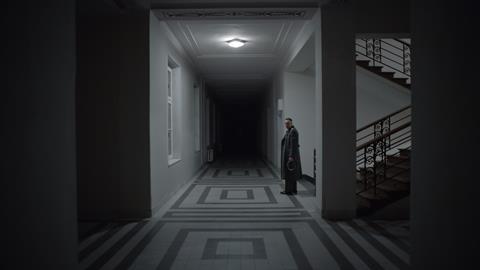
There is a recurring sequence during the film where a girl engages in some clandestine business in the middle of the night, leaving apples and pears for inmates in the concentration camp to find the next morning. It is stylistically certainly a shock, as the girl is shot on thermal imaging cameras to create a negative effect. Narratively however the sequences are positive as they serve as the only source of hope and optimism for the entire movie. Glazer has famously said he couldn’t have done this film without including this one sequence – in all the darkness there is light.
A hallmark of a poignant movie is the continuity of work and how there will always be something to clean, something to pick up, something to do. At the risk of spoiling the carefully crafted ending, I will say that this theme is eerily present, reminiscent of the ugly orderliness that defined the lives of those that undertook these monstrosities. The human condition in its ugliest form is shown in its view and treatment of other humans. Overall, the atrocities are so uncomfortable, so unspeakable, and in this movie completely absent from view, that you suffer more in imagination than in reality from Glazer’s film. That is a testament to his true greatness, how audiences are convinced they heard more than they really did.
A deserving Best Picture winner in my humble opinion, failing that, it is almost guaranteed Best International Film.
 FILM FOR THOUGHT