
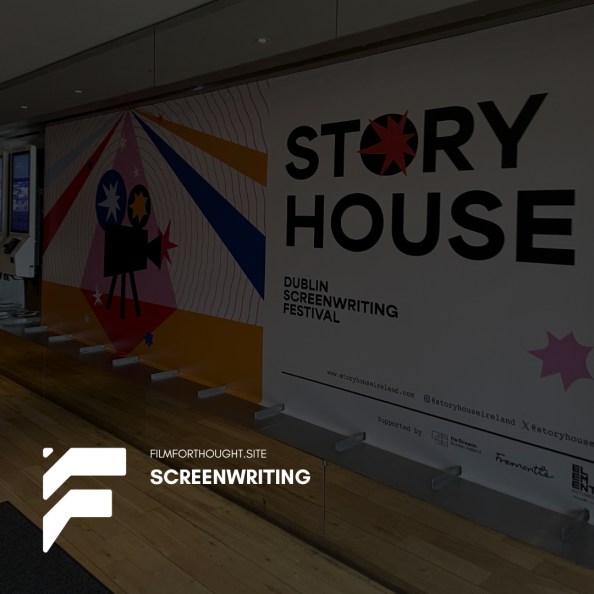
The inaugural Storyhouse Festival kicked off yesterday in Dublin’s exclusive event space the Lighthouse Cinema. The event was conceived by Element Pictures Co-CEO and founder Ed Guiney who wanted to bring Irish storytellers together in one place to share advice on the craft and the business of telling stories. The event kicked off with Guiney speaking about bringing Irish screenwriters to the forefront – not necessarily Irish-first stories – but Irish storytellers first. From the event it was obvious how important it is to support the writer and the creator first, optimise the script to its highest level so something new and exciting is what is ultimately presented to studios and commissioners. That is the highest form of art.
The day kicked off with a TV panel that included Emma Moran (Extraordinary), Namsi Khan (True Detective) and Baz Ashmawy (Faithless). ‘It’s important to trim the fat off writing,’ Moran said when speaking about her new Disney Plus show. Moran and Khan were the more seasoned writers and it was Ashmawy who with his new show Faithless which he wrote and starred in was his first and he offered some actionable points to up and coming writers. ‘Make sure your pitch document has the same tone as your script,’ Ashmawy said of the importance of pitching the tone within your pitch so it is clear from the outset what the personality of the script is. ‘It’s like script Cheltenham,’ Ashmawy quipped, ‘every producer wants you and your script to bring them home a winner.’
A case study later on in the day on Element produced The Dry written by playwright turned TV writer Nancy Harris echoed these sentiments of crafting the pitch deck. ‘Be playful and put some mischief into your pitch document.’ Harris spoke about The Dry which starts the series following Shiv home from London to Dublin who has recently gone sober. The series from there explores Shiv’s dysfunctional Irish family and an exploration of life and alcoholism in modern Ireland. While many viewers rightly see Shiv as the focal point and main character for the series, it is actually a five character show. ‘Not everyone’s crisis point can happen in the same episode,’ Harris says, speaking about the need to space out turning points that will accelerate plot.
The final slot of the day was reserved for Tony McNamara, the decorated screenwriter and Oscar nominee for The Favourite and recent Oscar darling, Poor Things. McNamara is the epitome of Aussie coolness, with a small town origin story himself and having not seen a play until he was nineteen, he takes everything in its stride. This chill factor is what he said drew him to Greek film director and long time collaborator Yorgos Lanthimos. He said the two understood each other so well from a Zoom call lasting just 12 minutes that left assistants panicking that the duo had cut their time short, when in fact Lanthimos simply said, ‘It’s good. We are good.’ And thus the dynamic collaboration of some of the most exciting modern cinema was born. It makes sense that such a powerhouse of cinema output is underpinned by calmness and collectivity. How else could it be done?
McNamara makes writing sound like the easiest and hardest job in the world. He says stoically that ‘the process of writing is the reward, the joy is that it is the only thing I can control.’ He keeps coming back to the work, and that work always starts with understanding what the character wants, ‘for weeks on end.’ McNamara has established decent boundaries, and his self preservation is not only protective of his work and time – but of his craft. If you give him space to breathe he will optimise his script to the nth degree – and that is the highest form of craft in this art form we love called screenwriting.
 FILM FOR THOUGHT