
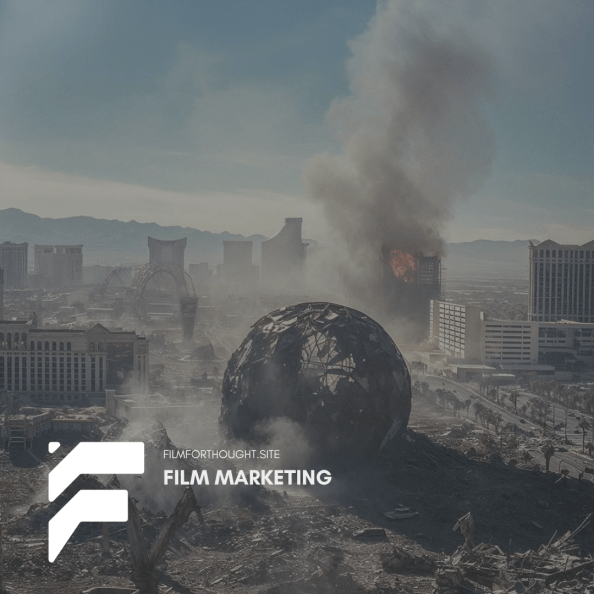
Last year actors and writers came out in their thousands and lined the streets of Los Angeles in protest of a pernicious threat to their jobs and livelihoods. That threat was the looming probability that studios were taking AI use to whole new levels, where they no longer enhanced human work – but replaced it altogether. Picket signs showcased the fury writers and actors were experiencing such as ‘we didn’t immigrate here to be replaced by AI,’ and ‘pay the writers you AI-holes.’ The strike is over, but the war on AI certainly isn’t, specifically when it relates to film marketing.
Civil War declared on AI
While the strike was an understandable response by industry workers worried their likeness and words would be replaced by AI, the latest uproar is closer to the end consumer. Civil War is the latest film to get caught up in this mess, which is the biggest swing ever taken in terms of budget by the mini major studio and industry darling A24. To many, A24 can do no wrong as a distributor that has managed to turn its unique choice of film acquisitions into a recognisable brand itself that signifies a quality seal to cinephiles everywhere. It has diversified into other areas, notably merchandise of its films in a strange but lucrative meta move that differentiates it from others and builds customer loyalty. For once in its steady fourteen year ascent to the top as the darling of indie curation however, it has ruffled some feathers.
This week A24 released a series of images depicting scenes of destruction in different American cities to promote Alex Garland’s latest film, Civil War. The problem is that none of the scenes come direct from the movie, they are a product of AI. The film itself is a hypothetical take on a future broken state as a result of political polarisation, and A24’s intention was clearly to ‘hypothetically’ depict such an event and its implications on the landscape of America. The role of AI was confirmed when on closer inspection it was found that the location of the Marina Towers in a deserted Chicago had magically moved to opposite sides of the river.

The response has been mixed, but has mainly generated negative press as a result of audience members who see this as an attack on art itself, which ironically A24 has so brilliantly championed for years. Such responses by the public made that clear, ‘for a company that seemingly values artistry, using AI generated works for advertising is a real bummer.’ There is an argument for giving A24 credit where it is due, as it has rightly created buzz and discussion that differentiates its first ever blockbuster film from its stale and risk-averse studio counterparts. This risk is something that the scorned studios (who are still suffering the dearth of product that the writers and actors strikes affected), could never do in its current environment.
Late Night with the AI Devil
And it’s not the first time this has happened. Last month, IFC Films’ latest experimental horror film ‘Late Night with the Devil’ was experimental in more ways than one. The film which has a distinct 70s feel to match the subject matter, went a step further and included some themed interstitials in the film – only they were created by AI. In its response to complaints, sandwiched among excessive plaudits for the team and over emphasising the ‘human element’ behind the film, IFC Films admitted that they had ‘experimented with AI for three still images which we edited further and ultimately appear as very brief interstitials in the film.‘
So where does the war end?
Is it false advertising? That is the question that is most pressing, as now it is a legitimate consumer issue. While not specific to AI, similar sentiments of being ‘cheated out’ of a particular experience happened in 2022 when two men who rented the film ‘Yesterday’ as they had seen actress Ana De Armas in the trailer for the film, only for her to be removed from the final cut. They sued Amazon Prime as technically their $3.99 was largely based on the unfulfilled promise of the very experience they had been sold.
It seems that for now, AI is in an experimental phase where companies are testing the boundaries of what they can do. With a film about a civil war as a result of polarising opinions, it’s no wonder that the team in A24 wanted to lean into the irony of the situation using one of the most divisive topics of our times. Civil War has shown that sometimes AI can be used simply for AI’s sake, which is likely exactly what A24 wanted to create PR momentum and organic conversation at a low cost. And what about the protestations of film marketers around the world that are worried their jobs will be replaced by generative AI? If A24 didn’t want to be found out, they would have made sure that AI moved the Marina Towers to the same side, but they didn’t – and that choice was made by a human.
 FILM FOR THOUGHT