
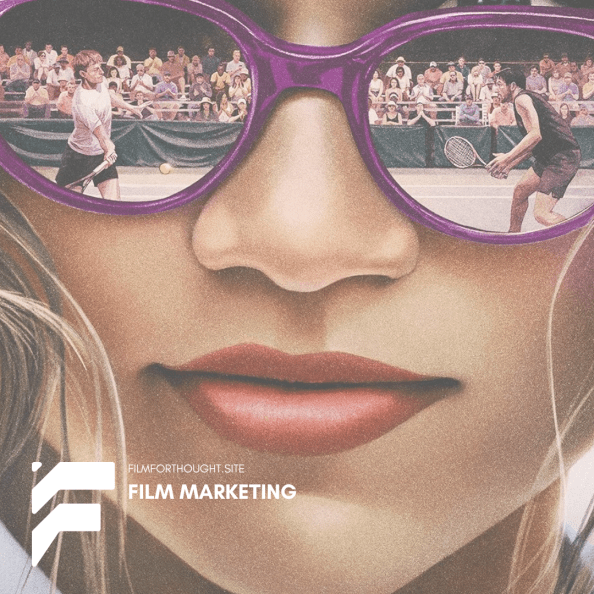
Welcome to the first edition of Film For Thought’s ‘Film Marketing Series – You Can Literally Market Anything,’ as we review how the Challengers film strategically generated a frenzy of hype and acclaim for a film that failed to serve up much. Film For Thought will examine the enduring truth of the film marketing business, which is the double-edged sword of film marketing: that given the right approach, you can literally market anything.
Last year the Barbie movie was everywhere, thanks to a $150 million marketing campaign. This is the world of Hollywood studio film marketing, in which films require a marketing budget of at least 50% of the film’s production budget – a small price to pay for delivering the awareness that would generate over $1.4 billion at the box office. A few years prior, Solo, Disney’s Hans Solo Star Wars spin off generated just $392 million at the box office. Despite Solo spending the same amount on marketing as Barbie had, the result (and the industry reaction) was very different. Headlines poured in lamenting the opportunity lost and that the marketing budget had signalled the death knell for the film, with analysts laying the blame squarely with the ‘poor marketing campaign.’
These films demonstrate an enduring truth in the film marketing business, which is the double-edged sword of film marketing. Many executives take the ‘diminished expectations’ approach, in which marketing executives at film studios will do their best to ‘pull a rabbit out of the hat,’ but nothing is guaranteed. On the other side, when a success like Barbie prevails, the studio revels in the accolades in a manner that makes it look like they were divinely inspired. In other words, marketing can be a scapegoat or a saviour depending on a studios’ objective.
What was so right about the marketing?
In July last year when Barbenheimer was in full swing, it was then that Film For Thought initially noted that you can literally market anything. Warner Brothers knew full well that in order to make a return on investment it had to dress the mutton up as lamb and serve it up proudly on the world stage, and they have gone down the exact same route with Challengers.
Challengers‘ release date was pushed out due to the strike, moving from August last year to this month. This was an early indicator that MGM / Amazon and Warner Brothers was going to go all out on marketing and star-power, which it couldn’t have done in the midst of the SAG strike. With Zendaya commanding a quarter of the film’s budget, they would need to utilise her in the strategy to get a return on investment, and for this reason Zendaya’s story was central to the campaign.
From an optics perspective, at the end of the summer last year, Zendaya spilled the beans that the former Disney channel alum was looking forward to her ‘first role as a leading lady.’ This film was acting as a turning point in her career and graduating from kids television and films. These kinds of transitions into new career eras generate significant press, and while this shift isn’t really on Miley Cyrus and her Bangerz era level of shock, it gave the media something to cling to early on. In terms of more surface-level marketing tactics, in a similar vein to Barbie, Zendaya was centre stage and she showed up to different press calls in stunning, tennis themed outfits. This was a key aspect of the Barbie campaign where the biggest question was: what Barbie character would Margot Robbie imitate on the pink carpet?
From the get-go, the film was positioned as a ‘must see’ for the Generation Z audience by speaking authentically in their language. As the storyline centres around a non-traditional, love triangle, over multiple years it appealed to the generation where anything goes and this was the correct route. Gen Z audiences obsessed over the storyline centering around the love triangle and were blind to the actual movie once they saw it as they’d already drank the Kool Aid.
What was wrong about the movie?
This is the amazing part. The movie was not good and I stand by that. It teetered on being a parody of itself at times when in the middle of emotionally charged scenes the characters would say ‘we’re still talking about tennis, right?’ just in case you had forgotten that the writer was using tennis as a metaphor for love and power.
Strange narrative tools were employed such as EDM music consistently playing over key dialogue, which added zero intensity and urgency to scenes. Also, multiple scene transitions were set up with ‘3 days before’, ‘2 weeks after’, ‘11,000 years later,’ which although necessary to the structure just resulted in over-complication. Furthermore, it suffered from having zero external characters that could have helped in clarifying the strange relationship the 3 of them had. Parent and child figures that were present could have been utilised as outsiders looking in, and the fact all 3 main characters never entered or left their own bubble, nor developed significantly within it was strange.
In terms of visuals, Guadagnino tried his best to make it different but it of course looked very similar to other sports based movies. He also strangely left all his experimental shots of a tennis match to the final scene and it didn’t work. The drama should have accelerated the climax – not the (film) shots. Zendaya is the best part about this movie and it’s a pity she is just the one watching tennis rather than playing for most of it.
It seems that Warner Brothers believes in marketing but not so much in its films. This should serve as an optimistic reminder that strategic marketing is powerful and it deserves its dues. It does not need to be seen as a risk if it is planned and strategic.
 FILM FOR THOUGHT