
Each year you hear about the Blacklist, the ‘hot scripts’ slinking around Hollywood, looking for a director to take them on. It’s commonplace in the business to chip and change until a script and director match up. But as writer-director Neil Jordan says, if you’re a director for hire you may aswell work as a traffic warden – you just end up moving the furniture and the lights around a bit while someone else calls the shots. The writer-director has historically been a risk in Hollywood, as the vision rests on just one person, but when it goes well, it enters the history books. Like singer-songwriters, a person who carries the tune of the words they write may as well be manna from heaven. With the passing of David Lynch last Thursday, the word ‘auteur’ has been very much back in the conversation, and with the wider cultural movement of emerging auteur directors it is a timely topic.
A Moment for David Lynch
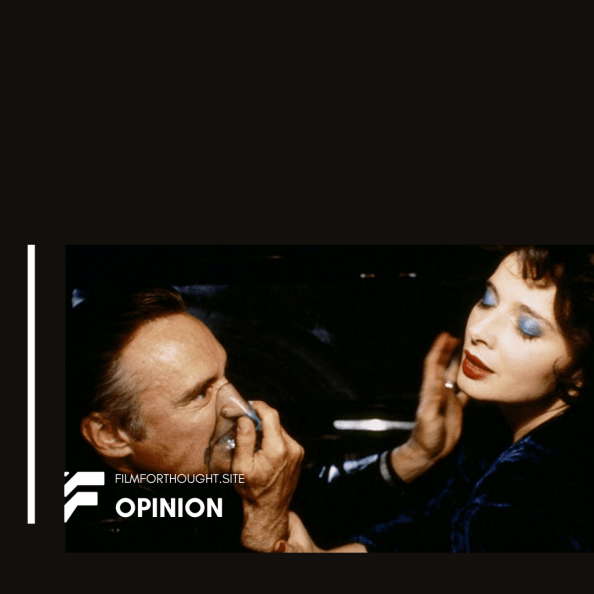
When David Lynch passed away last Thursday, the sheer volume of grief was clear, as people mourned the loss of truly one of the greatest American auteurs. Lynch went with quality over quantity as his CV has just ten feature films, a relatively short list compared to his contemporaries. But he was an artist across mediums, creating films, shorts and TV series across his career. In fact, while many cite The Sopranos as the beginning of the golden age of television in 1999, Lynch is regularly forgotten for his vision of capturing the attention of Americans with Twin Peaks which started in 1990. Blue Velvet is a personal favourite of Film For Thought, the seedy underbelly of white picket fence America has never been so vibrantly and violently portrayed. It kicked off a life-long career of working with Kyle McLachlan and Laura Dern, his vessels and collaborators for funnelling his art through.
Auteur Theory
The idea with Auteurs is that it encapsulates that directors’ signature, their stamp, scent and vision is across the film entirely. It is not that they are responsible for a certain kind of genre that makes them an auteur, it is that their stamp transcends genres and that their films as a whole are infinitely recognisable as their own. That Lynchian signature is one of pure art, having driven critics demented for years because they could never fully size him up. While critics could always pick out symbolism from other genre directors, Lynch remained an eternal unknown, like a Picasso painting you could never know exactly why he left in a particular brushstroke.
So what exactly is an auteur and where did it all begin? It first developed during World War 2 as a way of differentiating between politically approved films, and films that were embargoed. This came to light specifically during the Cannes Film Festival which was suspended due to protests in Paris, after a group of filmmakers including Jean-Luc Godard, François Truffaut, and Roman Polanski put pressure on the festival. This would ultimately change how the festival was programmed going forward, and showcased how important it was to be a politically independent festival with the auteur filmmaker at the forefront.
Auteurs – Visionaries from beginning to end
Why are films so long these days? Fifteen or twenty years ago 90 minute films used to be the standard. Now you’re lucky if a kids film is that short. Well, one of the prevailing theories is that with the move from physical celluloid film to digital has meant that people are more flippant with their shots, they can keep rolling for longer because no one is breathing down their neck saying that they’re wasting celluloid. The end result is that there is less onus on directors to economise. It therefore takes real talent, restraint and discipline to craft every frame. Denis Villeneuve, Robert Eggers, Andrea Arnold and Sean Baker, all are modern film auteurs, following in the footsteps of Quentin Tarantino, Wes Anderson and the like.
Younger, modern cinephiles are more astute, they recognise when a film is holistically conceptualised and created on screen. While the previous generation may have ‘stuck it to the man,’ this new generation after all are the ones responsible for for cutting out the middle man altogether as the original content creators. This generation therefore are actually primed the next generation of auteur directors. The director-for-hire theory of course works and will continue as long as cinema exists, but with the passing of David Lynch it has shown how taken people are by authors of their own art, and executing it exceptionally. After all, people don’t want to pick up a John Grisham book and discover that it was ghost-written by Gillian Cooper. They want authenticity, the vision of a singular person brought to life from start to finish and that is why Lynchian films will live on. We are all different and unique, and that’s why the auteur director will always have a voracious, loyal market.
 FILM FOR THOUGHT