

28th July 1954. Audiences were spellbound by a brand new film by the stage director Elia Kazan. On the Waterfront saw Marlon Brando star in one of his first leading roles, and brought a brand new style of acting that was far from the mid-Atlantic accent and stuffy theatre acting delivery. Martin Scorsese famously quipped that he was the marker in terms of cinematic realism: there is before Brando and after Brando; he is the marker. Seventy years have passed and it is still as revolutionary now as it was then.
Seventy years on and it holds the hearts of many in the cinematic universe. The mark this film has left is being rightly celebrated by Columbia Pictures with its re-release tomorrow on Friday 5th April. Having passed away in 2004, this week would have been the powerhouse of method acting, Marlon Brando’s 100th birthday. Coincidentally and quite incredibly, his fantastic co-star and love interest in On the Waterfront Eva Marie Saint is set to celebrate her centennial birthday this July.
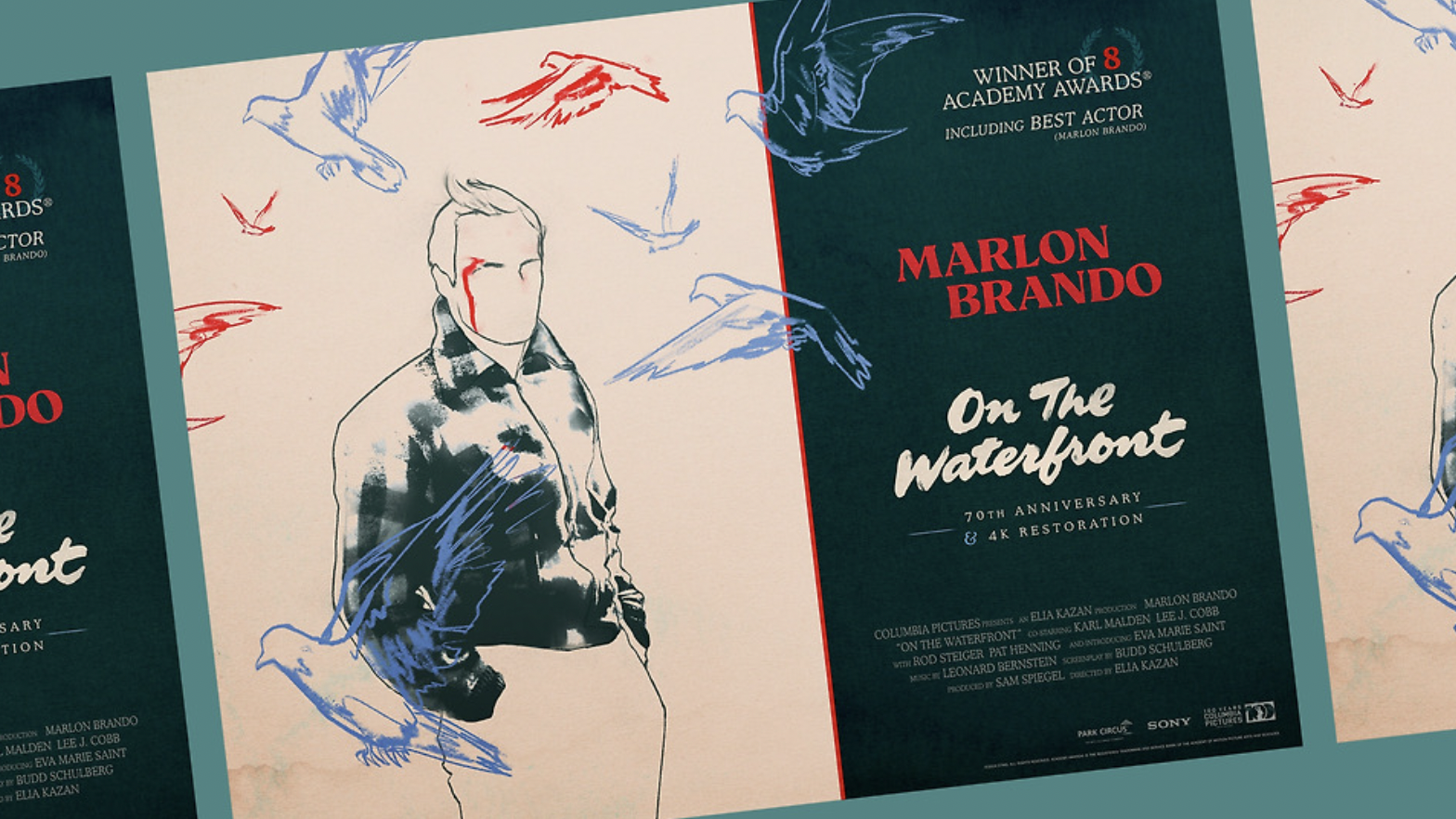
70th anniversary artwork
Budd Schulberg’s script is an undisputed masterpiece and despite his fortuitous and privileged upbringing, he managed to capture the true plight of longshoremen in 1950’s Hoboken. Those last five or six words in the preceding sentence are the PR buzz words that have swarmed the description of this film since its release date. It doesn’t truly encapsulate the nerves of steel you must call on to watch these broken men, who have no other choice but to engage with the pressures inflicted upon them by the local mob. Nor does it convey that universal sibling relationship complex between Brando and Steiger’s characters, the climax of which results in a brutal, but disarming exchange during the infamous taxi scene. Neither does it detail the sophisticated nuances of Brando’s demeanour.
Eva Marie Saint
Elia Kazan took a bet on Eva Marie Saint when he cast the young inexperienced ingenue as Brando’s love interest. Lookalike Grace Kelly’s would no doubt have brought a similar level of feminine guile to the role of Edie, but Saint played a blinder that ultimately would lead to her Oscar win. Where Saint portrays Edie in her most vulnerable moments, she simultaneously displayed fleeting indications of strength. Her soft and gentle prods at Brando’s troubled disposition serve not only as the films solitary female opinion, but as the films’ moral conscience. We can always identify with the thwarted and damaged soul of Brando, after all his defensiveness and street gall has been one of the films’ most infamous draws, but arguably it is Saint’s portrayal of Edie which resonates as reflections of our own longing to want to do better.
This film will make you feel something. Its script wasn’t perfect, but where it excelled was in their paradoxical dual presence of uniqueness and collectiveness. It is devoid of formula, and brimming with collective feeling. There’s a reason that films like On the Waterfront populate the resources of academic papers, film education and movie history. They were the trailblazers, setting a precedent for everything that came after and throwing out what came before. Their 20th century status shouldn’t dissuade you from viewing them; in fact you should consider their viewing a necessity. If you want realism, step back in time. If you want formula, keep spinning that suggestion carousel.

