
On the popular UK film review show, Kermode and Mayo, interviewer Simon Mayo opened a recent interview with filmmaker Mike Leigh by asking him to tell the audience what his new film Hard Truths was about. ‘I don’t want to talk about that. That’s a silly question,’ Leigh snapped at the relatively innocuous question. A bit much? From a PR perspective yes, it’s a basic requirement to summarise your work for the press, but from the artists perspective, is it such a simple question? Brady Corbet’s new film The Brutalist, which was released in the UK and Ireland last week is certainly an exploration of complex, interwoven themes that can’t be so easily summarised. The Brutalist has been a film to watch ever since its debut at the Venice Film Festival last year, but unlike ‘hot’ films like the recent erotic thriller Babygirl which causes a stir, but is ultimately a flash in the pan, Corbet’s film has maintained steady momentum. In large part it has been the work of A24, the indie marketing distributor-turned-studio powerhouse, having purchased the rights to the film which has managed to capture the magic of the film, and hit the right audience. The Brutalist has hit a sweetspot; it’s a cinematic epic, with an audience USP to back it up.
The Gordian Knot of a Capitalist Handshake
Film For Thought isn’t going to take the Mike Leigh route – we’ll summarise what we took from the meaning of The Brutalist. We meet Laszlo Toth leaving one life, and emerging into the next as the opening shot of the film follows him off the immigrant ship from Europe. The greatest, most beautifully constructed opening sequence follows, accompanied by an uplifting, jagged score as Toth glimpses Lady Liberty – upside down. “I believe in America,” the first words uttered in The Godfather, another filmmaking epic came to mind. Toth finds his feet in Philadephia, through an already assimilated cousin Attila, who has married a Catholic girl and changed his furniture store name to Miller & Sons despite not being called Miller, nor having any sons because ‘folks love a family business around here.’ Toth and Attila pick up piecemeal work, including being commissioned to redesign a library for the son of a rich industrialist Van Buren as a surprise for his father. Toth, an architect by trade, flexes his new-age design muscles on the project, but his creation is dismissed by Van Buren when he finds out the library has been gutted. The family refuse to pay the cousins, and Attila’s wife unceremoniously gives Toth the boot, so he’s back out on his own on the streets. The peaks and the pitfalls of the American Dream is already set in motion, you can be flying high one day and then down on your luck the next.
Dabbling in opiates and working on a construction site slinging coal, Van Buren seeks out Toth after doing his homework on his architectural pedigree, an acclaimed brutalist architect in his home city of Budapest. In a very public display, Van Buren leads a cocktail party group from his home up a hill, a deliberate procession set piece, and announces that he wants to commission Toth to build on this land a multipurpose community building. It’s clear that Laszlo getting involved with a visionary industrialist could be his saviour or his curse, the Gordian knot inherent in the capitalist handshake is irrevocably tied. Van Buren allows him to live in his guest house, and from then on the landlord and tenant dynamic is ever-present. The same man, a respected architect in his home country is now a serf and servant of his king’s land, and this is meant to be the dream everyone has searched for. Guy Pearse’s performance echoes the Mid-Atlantic, capitalist greed of the thundering John Huston in a similar role in Chinatown. Van Buren with his wealth is the visionary and will get what he wants, with those like Toth left as collateral damage in his wake. As Huston himself said in Chinatown, ‘you bring the water to LA, or LA to the water, no matter what gets in your way.’
American idealism versus European realism
Eventually we begin to look at Laszlo not as a victim of circumstance, but a willing participant, understanding the necessity to take risks and live through the consequences. Using Philadelphia as a backdrop, an Eastern blank slate, with a field ripe for redesigning is an apt setting for Corbet to question the foundations we are all built on and at what cost we are willing to sacrifice ourselves for our art, purpose and legacy. Painters after all are only at the behest of the ravages of their own mind and the amount of paint they can afford in a given week, while architects on the other hand are at the behest of investors with scale and money who have the power to visualise and bring their art to life. It’s that push and pull of American idealism versus European realism that emerges. It brought to mind the visions of Roman Polanski and Billy Wilder, survivors of the same war who fled to Europe but brought their groundedness with them to a Hollywood that was equally fond of their visions as they were afraid. They participated, however reluctantly in the Hollywood machine to get their work on screen. The first half of the film is very much the American Dream in full flight, and and a romantic would have left it there. But a brutalist, a realist persevered and showed the ugly sides of the pursuance of it. The suffering is part of that dream, what is left standing after is what matters.
The unique audience proposition
Speaking of suffering. This theme is inherent in the film, but it’s also evident in the making of the film. Against all odds 1. The Brutalist is a small budget (yes $10 million is considered small in Hollywood) project 2. It was filmed entirely in Vistavision, a now defunct technology and 3. has a run time of three hours and thirty five minutes with an intermission with a countdown clock built into the DCP.
Let’s talk about the release strategy. After a Venice Film Festival acquisition by A24 in August, a platform release was rolled out in key cities (the two coasts LA and New York) just before Christmas. Word of mouth helped to gain momentum and the milestone to expansion to 300+ theatres domestically coincided the week of the UK release. A small platform release early, and timed with the awards calendar helps to protect the length of the release and extend it for a greater time period than going wide straight away. That isn’t a necessarily groundbreaking strategy, the three dimensional marketing was.
The credits move from East to West, like the characters in the film
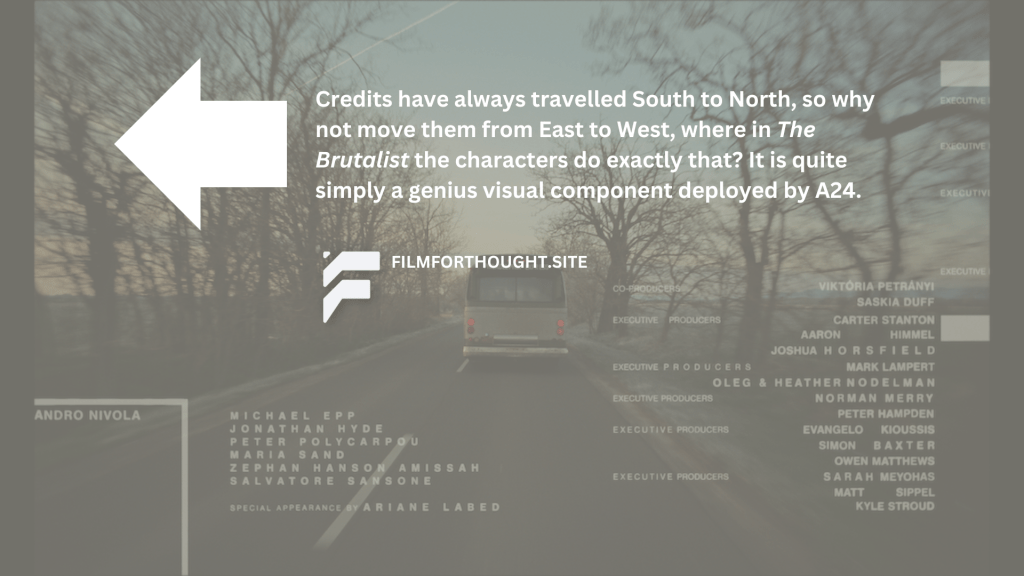
A24 is acutely aware of how specific, targeted marketing muscle can be used to promote further growth of a film. Its strength is in helping independent filmmakers to engage with the end consumer from the outset, rather than just at the end of the value chain. The visual parts of the campaign included an arresting title treatment, the film title tilted like Lady Liberty herself in the opening scene, using a bold, angular font in the brutalist style. Trailers mimicked the style of the films actual credits, moving from left to right. A relatively innoculous move, but when you think about it, credits have always travelled South to North, so why not move them from East to West in a film where the characters do exactly that? It is quite simply a genius visual component deployed by A24.
But beyond the visuals, it was the accompanying narrative, Brady Corbet’s true struggle and strife to get this film to audiences. Using a defunct technology with Vistavision took time, effort and patience, while the three and a half hour run time was the least attractive part for potential buyers. His eloquent interviews have dovetailed nicely with the struggle of the central character in the film. Laszlo toiling to get his life’s work built, Brady Corbet triumphs and succeeds to get his life’s work on screen here. It’s a film that can be interpreted in many ways, and isn’t so easy to summarise and commercialise but somehow A24 harnessed the unique selling points of the film itself and the accompanying struggle to make it and turned it into a must-see experience. The film is a passion project come to life, an achievement in filmmaking, making it a unique proposition for audiences. Like the Laszlo’s carefully constructed buildings take time brick by brick, so does it take time and restraint to produce a three and a half hour epic.

