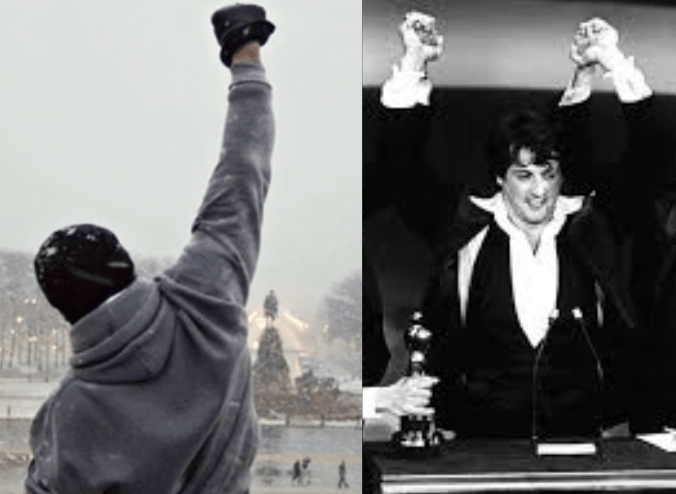

There was something in the water in 1976, it is regularly heralded as one of the most competitive years in cinematic history. There are countless years where Best Picture nominees get lost and forgotten, failing to carry on that status for years to come. These films however are still today considered some of the absolute giants of cinema, and they all come with their own unique lore. Rocky, Taxi Driver, All the President’s Men, Bound for Glory and Network – all of them now have icon status, and once upon a time they went head-to-head against each other. We have ten films nominated for Best Picture this year, and one will be crowned ‘the best’ in just a few weeks. But let’s rewind for a bit – back when just 5 films were nominated for Best Picture, they were really the creme de la creme and this is particularly evident 50 years ago.
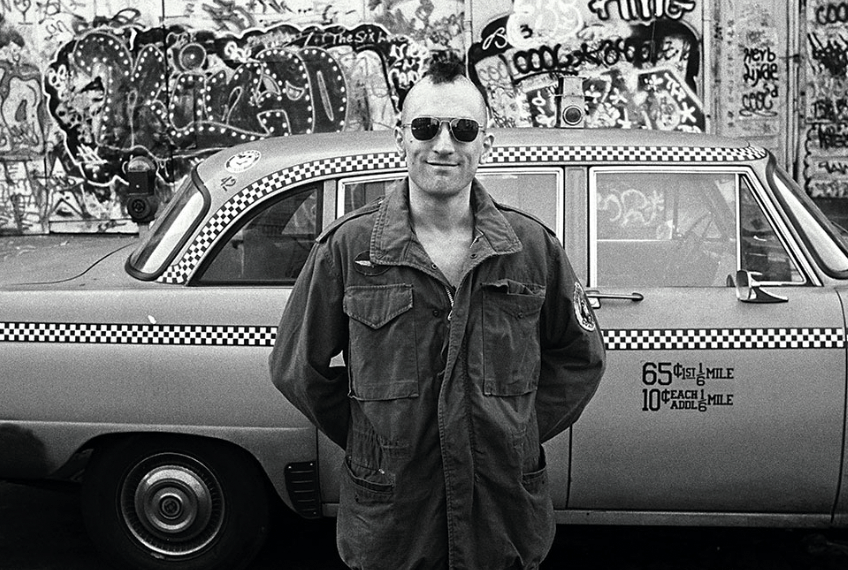
Taxi Driver
Paul Schrader’s mind, Martin Scorsese’s vision, Robert De Niro’s malice, and Bernard Hermann’s haunting, howling score, a masterpiece was born. This was the 1970s, when a tragic and troubled individual intent on assassinating a politician and on saving a young girl from a pimp could be financed by a commercial studio. This was a time when the inmates were running the asylum. Fresh off a Palme D’or win in Cannes, Taxi Driver was, and is, such a unique film. It’s a tapestry that weaves in every on-screen, mental struggle we’ve seen, given that we rarely see this menacing spiral into madness. In Taxi Driver, De Niro played Travis Bickle, whose self-imposed exile in his bright, lucid yellow Manhattan cab remains a marker for the deeply flawed and self-destructive anti-hero. It got its recognition that year, in addition to nominations for Best Picture, best actor, best supporting actress and Best Original Score for Hermann who by all accounts, composed the score in his study and then dropped dead later that evening. It however, failed to pick up the Best Picture win.
Network
If you’ve ever heard the phrase, ‘I’M AS MAD AS HELL, AND I’M NOT GOING TO TAKE THIS ANYMORE!’ – Network is the reason why. The satirical drama looks dated now, but its principles remain relevant in an era of live streaming, echo chambers and extremism. A veteran news anchor Howard Beale who is played by Peter Finch announces on air that he will kill himself – and his ratings soar. The morbid curiosity gets the better of people, and the network of course, are caught between a rock and a hard place – offer a duty of care to the anchor (what’s that – it’s the seventies!) or simply exploit him and draw in a greater audience. It raked in a phenomenal 10 nominations, including most of the crafts and two best actor nominees. With life imitating art in a cruel way, Peter Finch’s career was resurging as a result of the film – but tragically he passed away a month before the Academy awards in which he won Best Actor posthumously. This of course created one of the most infamous photos in Hollywood, of Faye Dunaway, Finch’s castmate, by the pool in the Beverly Hills hotel with her Oscar, surrounded by swathes of newspapers documenting Peter Finch’s posthumous win – the ‘mourning after,’ if you will. The film itself and its real life telling is steeped in its own tragic lore. Network failed to scoop that Best Picture win despite hitting the zeitgeist.

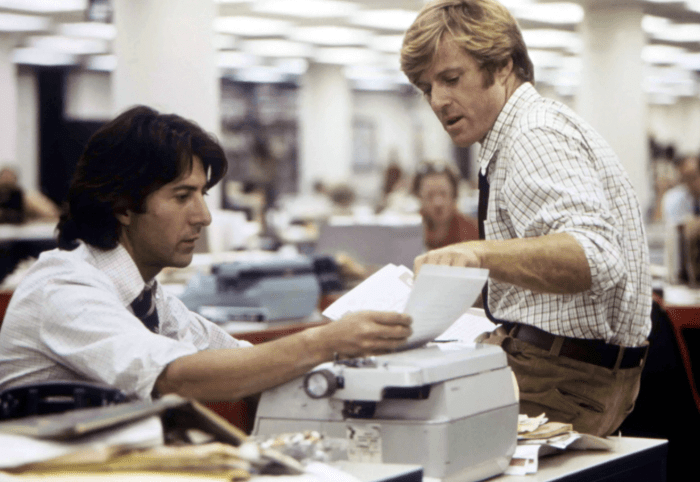
All the President’s Men
It’s every aspiring writers favourite film. In All the President’s Men, Dustin Hoffman and Robert Redford played Woodward and Bernstein, the two Washington Post journalists who tirelessly snooped around Washington DC and beyond until they found the chain that Nixon had spinelessly set up for his own self-serving purposes. Unlike today when everybody and their mother involved in a historic event writes a book and dines out on it for the rest of their lives, the real life Woodward and Bernstein were hesitant for the film to be adapted, and this set Robert Redford off on his own piece of investigative journalism to secure the rights. Alan Pakula’s direction is immaculate, and faced with an impossible task (how can you make typing and other seemingly innocuous tasks of journalism pacy?) he absolutely came out on top. Like his other masterpiece Klute, where he closed in on the audience, making the viewer claustrophobic he meticulously follows Hoffman and Redford as they uncover the web of lies. He makes reading documents interesting, and he created a genre of investigative dramas that will be replicated for years to come. With eight nominations and four wins throughout the night, it was hugely topical at the time, (it would be like someone doing a film on the Epstein scandal in 2026) and the film that so perfectly chronicled how the Watergate scandal became an era defining moment in US political history could have easily clinched that Best Picture win – but it didn’t make the final cut.
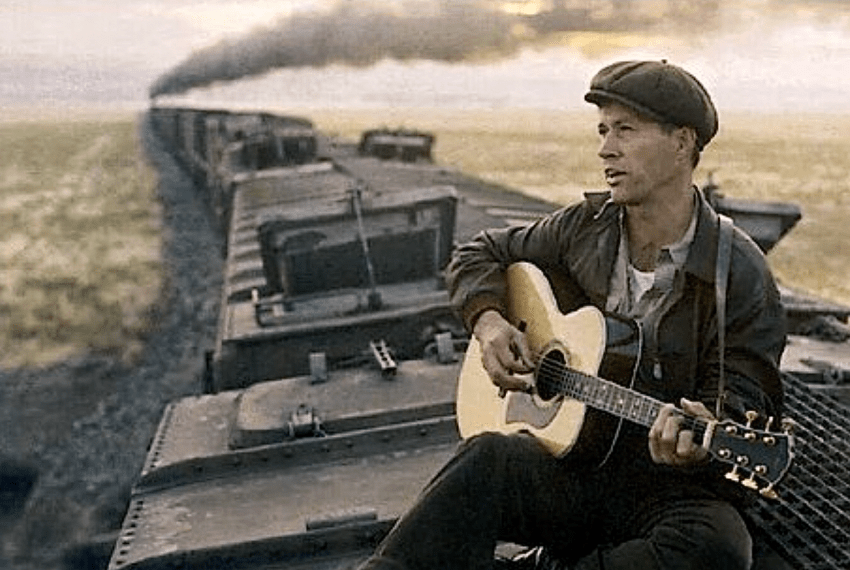
Bound for Glory
Bound for Glory is a biopic of folk singer Woody Guthrie, chronicling his life during the Great Depression. The biopic recieved 6 nominations and won 2 including Best Score, beating the late Hermann for Taxi Driver. Robert Carradine played the title character of the folk singer, and follows a fictional story structure of Guthrie’s life. As a biopic of a folk singer, the songs make it or break it and that’s where it prevailed. It is known for being fairly predictable in terms of hitting all the notes of a typical biopic, but at least audiences got what they came for. A good film on a technical basis, but in hindsight I can see how this Depression-era folk film was simply too square for 1976.
Rocky
Against all odds, the underdog did it. In the years since, the Rocky franchise has exploded into its own seperate entity, and the commercialisation of the franchise has chipped away at the heart and soul of the original. But back then, Sylvester Stallone’s self-directed, self-written, and self-performed film about a boxer down on his luck was fresh and most importantly – independent. The road to the top wasn’t easy however, with Stallone pedalling the script around Hollywood, but he was consistently met with shrugs – he was an unknown actor with a crooked smile who wanted to star in it. After a lot of rejection, United Artists were the group to take a chance on Stallone’s dream, his determination aligning with that of the main character. The budget was set at $1m, which even at the time was miniscule, and they set off to make the ‘little film that could.’ Rocky captured the hearts of audiences, it was a commercial hit with an indie spirit and the risk had paid off. Stallone lifted that Best Picture oscar just like he had punched the air at the top of those Philadelphia steps. Rocky had 10 nominations going in, the same as Taxi Driver and Network, so it was in stiff competition from the start. But Rocky’s Best Picture win is only obvious in retrospect – it was the underdog that had a shot, and all you need is one shot. Stallone’s personal story drove the narrative that year – after all, the Rocky tagline in promotional materials was ‘his whole life was a million-to-one shot.’